CoRE in Interdisciplinary Peace Research NCIRI Seminar Series (Second)
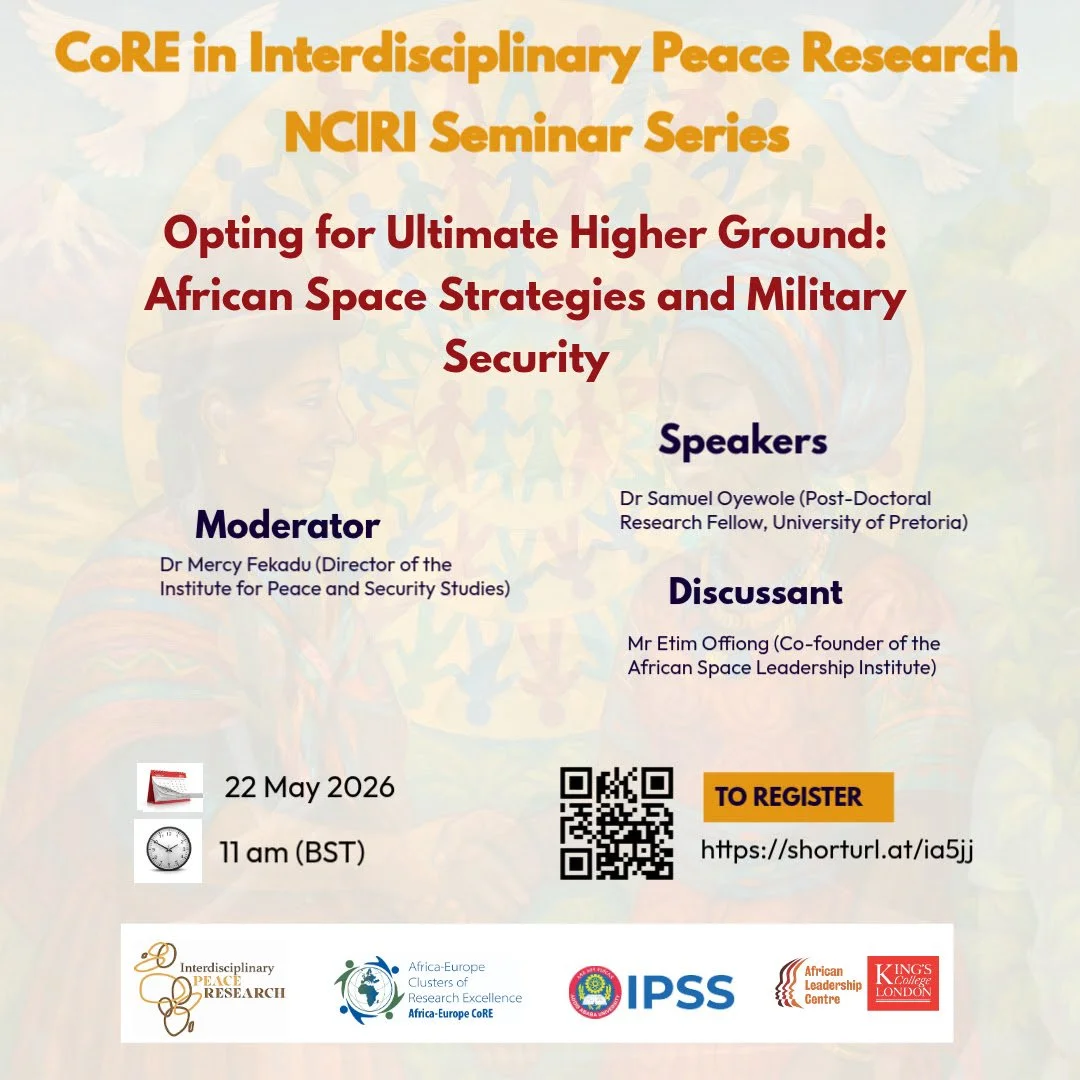
The African Leadership Centre (ALC) and the Institute for Peace and Security Studies (IPSS), Addis Ababa University, and all partners are pleased to invite you to our second NCIRI seminar series event titled, “Opting for Ultimate Higher Ground: African space strategies and military security”, which will be held on Friday, 22 May 2026, at 11 am (BST).
The Nurturing Capacities for Interdisciplinary Research and Impact (NCIRI) Seminar Series is a new initiative from the ARUA-Guild Cluster of Research Excellence (CoRE) on Interdisciplinary Peace.
Abstract:
Since ancient times, elevated terrain has held strategic and tactical value in defence and security calculations. Many precolonial African societies and states, like their counterparts elsewhere, understood this logic when they chose higher ground and mountainous areas for settlement, defence, and security. Beyond natural landmarks, however, the invention of elevated and flying objects has transformed defence and security. Accordingly, land and sea powers benefited from the advent of towers, while the advent of balloons, aircraft, and missiles ushered in the age of airpower, which is modern-day higher ground. Meanwhile, the ultimate higher ground is a product of the space age, defined by the advent of orbital launchers and satellites.
In addition to land, maritime, air, and cyber spaces, a growing number of African countries are opting for the ultimate higher ground by exploring space and the attendant technologies for their development and security. While the continent remains dependent on externally provided space technologies and services (including navigation, communication, and remote sensing), many African countries are developing their capacities and capabilities through strategic investment and international partnerships. Some 30 African countries have developed space policies, institutions, capacities, facilities, and/or technologies. Since 1998, over 70 satellites have been co/sponsored from Africa, with 20 countries co/owning and operating at least one. Although the space strategies and capabilities of African countries are predominantly administered by civilians and designed for research and development purposes, there is also a growing military and security dimension.
Africa has witnessed two major waves of military space strategy. In the first wave, between the 1950s and 1990s, South Africa, Egypt and Libya prominently pursued militarised space strategies and capabilities, which were derailed by domestic and international political dynamics. The second wave of militarised space strategies became notable in Africa from the 2010s. Since 2014, South Africa, Morocco, Egypt, Nigeria, and Algeria have sequentially orbited dedicated military or dual-use satellites to boost their defence and security postures. Furthermore, Nigeria and South Africa have publicly launched military space commands or entities. These, and other African countries, have also employed civil and commercial space technologies to support military security. Beyond status and prestige, the need for and deployment of military space strategies have increased with various internal, transnational, external, and situational security threats across Africa. However, these developments and their implications have received limited academic and policy attention.
Consequently, this presentation examines the growing interests, developments, and deployments of military space strategies and capabilities by African countries, the strategic opportunities and motivations involved, and possible implications for national, regional, and human security.
This presentation builds on the speaker’s early research, including "Space research and development in Africa" 2017; "The quest for space capabilities and military security in Africa" 2020; "Air and space strategies in African disaster management", 2022; "Military space strategies and African realism", 2024; Utilitarianism in Outer Space: Space Policy, Socioeconomic Development and Security Strategies in Nigeria and South Africa, 2024.
Moderator:
Dr Mercy Fekadu, Director of the Institute for Peace and Security Studies
Speaker:
Dr Samuel Oyewole, Research Fellow at the African Center for the Study of the United States (ACSUS) and the Ocean Regions Programme (ORP) of the Department of Political Sciences, University of Pretoria, South Africa, and a Lecturer at the Department of Political Science, Federal University Oye-Ekiti, Nigeria.
Discussant:
Etim Offiong, Co-founder of the African Space Leadership Institute (ASLI), Africa’s first think tank focused on the exploration, use and governance of outer space.
You can pre-register your interest to attend LINK